The kinds of Solutions and Colloids!
And also we will be talking about the benefits and risks of said Solutions and Colloids.
First up: Solutions!
There are three types of Solutions:
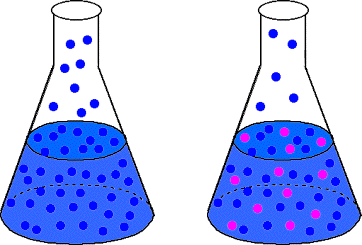
1. Gaseous Solution - includes gases or vapors dissolved in one another. Two or more gases can form a solution. Air is an example of a gaseous solution. When dry is made up of oxygen gas dissolved in nitrogen gas.

2. Liquid Solution - contain a liquid solvent in which gas, liquid, or solid is dissolved. Water is the most common liquid solution. Many things can be dissolved in it. Table salt is an example of a solid dissolved in a liquid. A liquid and a gas can also be dissolved in a liquid solution.
 3. Solid Solution - is a mixture of solids spread equally throughout one another. Metal is an example of a solid solution at room temperature.
The benefits of such things are the following:
-Food (Most food are solutions)
-Drinks (Almost every beverage is a solution)
-The creation of most metals
-The creation of important resources and materials
The risks of such things are the following:
-Some certain solutions make poisons and toxins, these can be Gaseous, Liquid, and Solid.
Next up: Colloids!
These are all the kinds of colloids:
* solid particles dispersed in a gas (solid aerosol); example: dust in air * liquid droplets dispersed in a gas (liquid aerosol); example: cloud * solid particles dispersed in a liquid (sol); examples: slime, paste * gas dispersed in a liquid (foam); example: whipped cream * liquid in a liquid (emulsion); example: hand lotion * gas dispersed in a solid (solid foam); example: foam rubber * liquid dispersed in a solid (gel); example: jelly * solid in solid (solid sol); example: some glasses
The benefits of such are the following:
-Food (Some foods are actually solids, example: Marshmallows, etc.)
-Drinks (There are plenty of beverages that are colloids)
It is still undecided if "Colloidal silver" is safe or not.
F.A.Q. (Frequently Asked Questions):
Q: How do you tell apart Solutions and Colloids?
A: Colloids can be distinguished from solutions using the Tyndall effect.
A beam of light passing through a true solution, such as air, is not visible.
Light passing through a colloidal dispersion, such as smoky or foggy air, will be reflected by the larger particles and the light beam will be visible.
Q: Are all Solutions and Colloids safe?
A: As mentioned, while most of either are safe, there are still plenty of unsafe and dangerous substances.
Q: Can you handle all Solutions and Colloids with your bare hands?
A: No, some are corrosive and may damage and cause harm to you.
